The Lamb + the Serpent
“Once you realise the Lamb and the Serpent were selected with precision, that the Bible is genius, it becomes impossible to read casually again.”
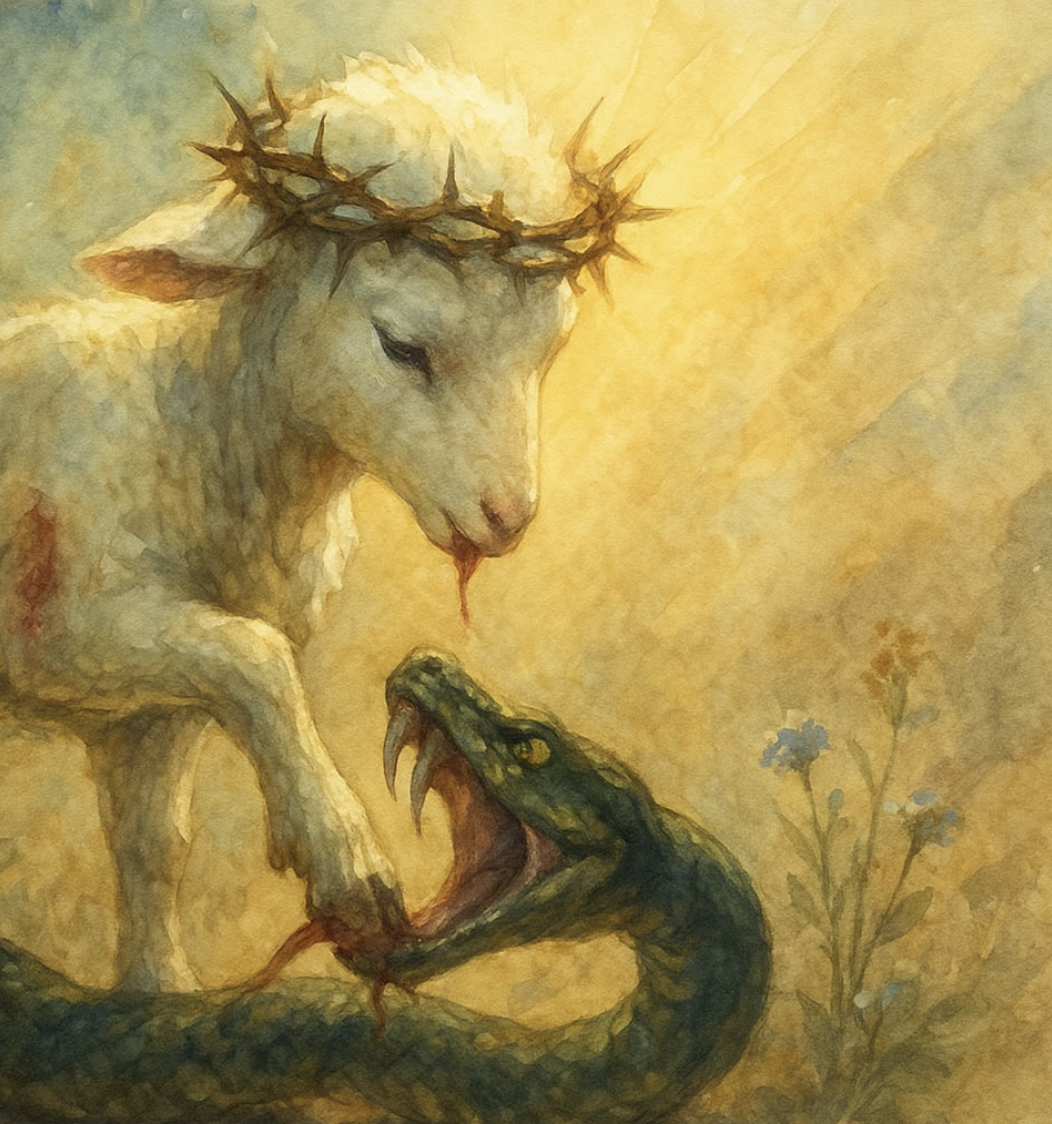
The Lamb and the Serpent
Why the Bible Is Smarter Than We Ever Gave It Credit For
Have you ever noticed how rarely we question the images we were given early on? Not because they don’t matter, but because they felt settled. Explained. Finished. We accepted them, carried them with us, and moved on.
That’s how it was for me with the serpent and the lamb.
I used to think I understood why Satan was depicted as a serpent. Maybe you did too. Snakes are Sneaky. Slippery, Deceptive. Unsettling. They strike when you’re not looking. It’s the kind of explanation that feels obvious enough that you don’t stop to examine it. You just accept it and move on.
I thought I understood Jesus and the Lamb in the same way. Innocent. Gentle. Sacrificial. Jesus as the Lamb of God, Again, it made sense, in a good enough way. Lambs were used for Sacrifice. The kind of understanding that lets you close the book and carry on with your life.
And for a long time, I didn’t think there was anything wrong with that.
It wasn’t that the explanation was wrong. It was that it felt finished. And I’m beginning to see how often I’ve mistaken that feeling of completion for understanding in so many areas of my life.
A few weeks ago, my husband said something that caught me off guard.
He didn’t grow up with God or Jesus at all. None of the language, none of the stories, none of the background I was raised in. And yet, for months now, he’s been walking beside me — coming to Mass, listening patiently as I talk about my growing love for Jesus Christ, supporting something he didn’t yet fully understand.
We were sitting together watching a YouTube video when he suddenly said, almost quietly, almost to himself, “Oh… that’s why they call Jesus the Lamb. Because He was a sacrifice.”
It wasn’t said with doubt. There was no resistance in it. Just recognition. One of those moments where something finally settles into place.
And it stopped me.
Not because he was wrong, he was right, but because I realised how long he had been walking with me in support post watching my very real and unapologetic conversion occur right before his very eyes, without that piece ever having been clear. How easily we assume shared understanding simply because we’re close to one another. How much faith can be present even before the language catches up.
I don’t know exactly why that moment stayed with me the way it did. Maybe because it reminded me that understanding often arrives quietly. Not through argument or force, but through proximity. Through staying. Through a love that listens long before it comprehends.
It made me pause, and it softened me.
Because if someone can walk alongside Christ without yet knowing all the names or meanings, then perhaps the work of God is gentler and more patient than we often imagine. And perhaps the Lamb has always been drawing us closer long before we know how to explain why.
And what struck me wasn’t that he’d finally “got it.”
It was that I realised how many times I’d had that same moment, and then stopped there.
Maybe you recognise that too. That quiet sense of oh, okay when something clicks. The relief of it making sense. And then life moves on, and the explanation settles into the background, untouched.
Lately, I’ve been noticing how Scripture seems to meet us exactly there, at that first level of understanding, and then it waits. It doesn’t push. It doesn’t demand that we go further. It just stays open, as if trusting that one day we might feel the nudge to return and sit with it a little longer.
I’m not sharing this because I’ve moved past that place. I’m sharing it because I’m realising how long I lived with that settled understanding without knowing it. How easy it is to assume understanding when what we’ve really been given is an introduction.
If you’re reading this and thinking, that’s me too, then you’re not late and you’re not behind. You’re exactly where many of us are, standing close enough to recognise a story, but just far enough away that it hasn’t fully opened yet.
This is what makes life journey so magnificent.
That’s where I’m standing now.
And if you’re willing, I’d like to stay here together for a moment more so I can share what the next understanding has been for me this week.
Recently as I have had more time on my hands, I have been opening the Bible every day, relation-shipping with the Holy Spirit is a huge part of my day, and due to this while The stories in the bible, haven’t changed, my experience of them has. Certain images have begun to feel more deliberate in a way I hadn’t accounted for before.
Have you ever had that experience? Where something you’ve known for years suddenly feels different, not because it has changed, but because you have slowed down enough to really see it?
That’s when it dawned on me that Scripture doesn’t behave like an ordinary book. It doesn’t reward speed. It doesn’t open itself through accumulation or effort. It opens through attention. Through staying with a detail long enough to ask not only what it means, but why it was chosen in the first place.
Take the serpent.
In the ancient world, a serpent wasn’t primarily a symbol of dishonesty. It was a carrier of venom. Venom doesn’t announce itself. It enters quietly, spreads internally, and corrupts systems from the inside out. Left untreated, it destroys life, not immediately, but progressively.
When you hold that in mind, the Bible’s description of sin begins to read very differently. Sin isn’t framed first as rule-breaking or bad behaviour. It’s described as something that enters the human condition, as it did eve, it is something that spreads, something that alters how we think, desire, relate, and choose. It contaminates before it condemns. It enslaves before it punishes.
The serpent, then, isn’t just a villain in a story. It identifies the mode of sin. Sin works internally. Quietly. Persistently. It doesn’t simply make people worse, it makes them unwell.
A distinction that matters.
Because if sin is merely misbehaviour, the solution is education or self-control. But if sin is contamination, the solution has to be cleansing.
This is where the Lamb comes in.
In the biblical world, sheep were not chosen at random. They were central to daily life, covenant worship, and survival. Sheep were used in sacrifice not because they were gentle or sentimental, but because they represented a specific kind of life: uncorrupted, undefended, and wholly and openly given.
Blood of the lamb, in this context, was not symbolic decoration. It was understood as life itself. To shed blood was to release life. To apply blood was to cover, cleanse, and restore what had been compromised. This is why Christians say I am covered by the blood of christ. I have been cleansed of my sins thanks to Jesus and I will thank him for the rest of my days.
This is why the sacrificial system exists at all. It wasn’t about appeasing an angry God. It was about cleansing contaminated people so that relationship with God and themselves could be restored. Sin created separation not because God withdrew, but because corruption cannot possibly coexist with holiness.
So when Jesus Christ is called the Lamb of God, this is not poetic imagery layered onto His life. It is a declaration about how sin is dealt with. Not through moral instruction. Not through self-improvement. Not through false light woke spirituality, But through the offering of innocent life that cleanses what has been internally compromised. Jesus was the only man that has never sinned, this is why it had to be him.
This is where something clicked for me.
Even recently, I found myself pausing over something I hadn’t noticed before. In modern medicine, antivenom is produced by introducing small, controlled amounts of venom into sheep. The sheep do not die. Instead, its body responds producing what is needed to neutralise the poison. And that life-preserving substance is then used to save others who have been bitten.
What struck me wasn’t the science itself. It was the pattern.
Something deadly is introduced.
Life absorbs it without being overcome.
And what is produced becomes a means of rescue for another.
I’m not suggesting Scripture is teaching immunology. But I couldn’t help noticing how closely this mirrors the way the Bible speaks about sin, life, and redemption. How often God answers what destroys from within not with instruction or effort, but with life given on behalf of another.
It felt less like a proof, and more like an echo, a reminder that the logic Scripture uses has a depth we’re still catching up to.
And it made me slow down again.
The Bible is not teaching modern medicine. But it is revealing a consistent structure of reality. Poison spreads internally. Life must intervene internally. Cleansing is required before healing can occur.
The serpent bites.
Poison spreads.
Life intervenes.
Cleansing restores.
That is the logic of antivenom.
And that is the logic of the Gospel.
Once you see this, sin stops being a vague religious word and starts making sense of human experience. Why shame lingers. Why patterns repeat. Why knowledge alone doesn’t free us. Why people can want change sincerely and still feel internally bound.
The Bible isn’t obsessed with sin because it’s moralistic. It’s obsessed with sin because untreated contamination destroys life. And it doesn’t offer condemnation as the solution. It offers cleansing.
This is why Scripture continues to unsettle people. We live in a world that wants forgiveness without transformation, spirituality without cost, and healing without surrender. The Bible refuses that framework. It insists that cleansing precedes freedom, that life must be given for life to be restored.
And that’s why the serpent and the sheep aren’t just images we inherit from childhood stories. They are the structural spine of the entire narrative. Once you notice the intelligence of it, it becomes impossible to unsee.
If you’ve ever felt drawn to Scripture but unsure how to approach it, maybe this is an invitation to begin again, not by reading more, but by reading more slowly. Staying long enough with the text for it to diagnose before it heals. To cleanse before it comforts.
You don’t need to resolve everything.
You only need to pay attention.
That is where the Bible begins to open us. I am having the time of my life reading a book that seems to touch every cell with resonance. It gives language and structure to a depth of meaning I have always sensed was real, even before I knew how to name it.
We will never comprehend the full genius of Scripture with a three-pound brain, nor will we ever contain God within our thinking. But to arrive at a place where life begins to make sense, not in a simplistic way, but in a coherent one, feels exactly like what the human soul has been searching for all along.